
An aquarium has a lot going on. We think about filtration, oxygen, lighting, décor, compatible fish, plants, and food. Then there is the biggest ingredient of all: water.
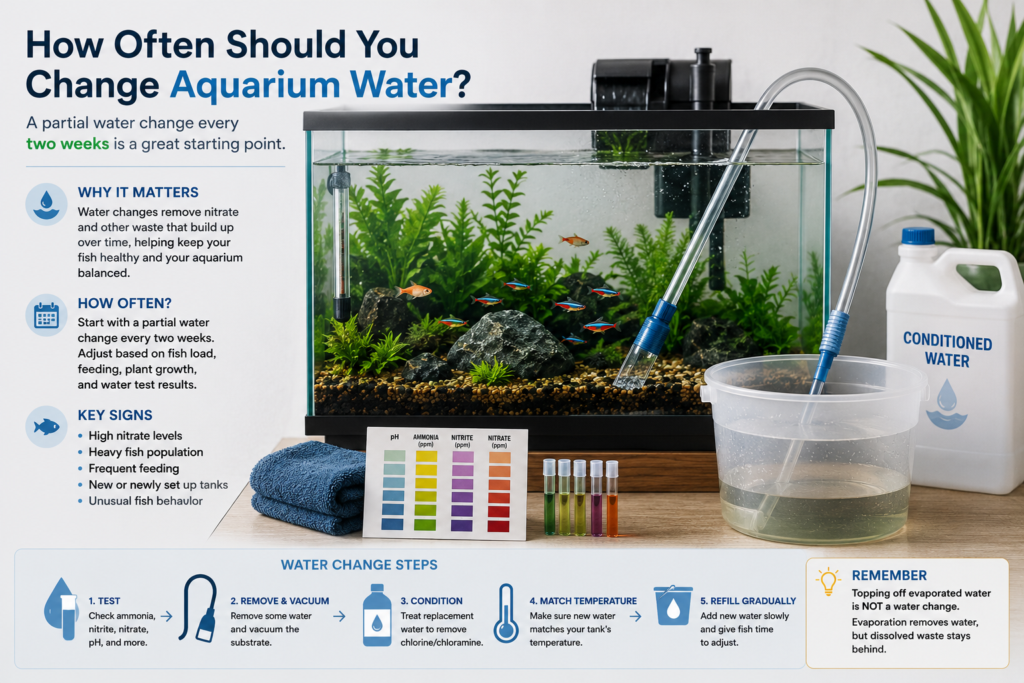
For many established aquariums, a partial water change every two weeks is a useful maintenance starting point. Your aquarium’s stocking level and water-test results should determine the actual schedule.
For a fishkeeper in Hoffman Estates, that means putting water changes on the calendar instead of waiting for the tank to look dirty.
Why Do Aquarium Water Changes Matter?
Your filter handles important mechanical and biological work. It cannot remove every dissolved waste product, though. Fish waste and decomposing food contribute to ammonia. Beneficial bacteria convert ammonia into nitrite and then nitrate.
Nitrate accumulates over time. Partial water changes help remove it from the aquarium.
That matters for a community tank near Schaumburg as much as a planted aquarium in Bolingbrook. Clear water does not automatically mean healthy water.
How Often Should You Change Aquarium Water?
Start with a partial water change every two weeks, then adjust based on your aquarium’s test results. Heavier stocking can mean more waste and a greater need for water changes.
Pay closer attention when:
- Your aquarium has a heavy fish population.
- You feed frequently or generously.
- Nitrate rises significantly between changes.
- You have recently added fish.
- Your aquarium is newly established.
- Your fish show unusual behavior or signs of stress.
New aquariums need extra attention. Ammonia and nitrite can rise while the biological filter develops, so frequent testing becomes especially important.
That is worth remembering if you are setting up your first tank in Bartlett or building a new aquatic display in South Barrington.
How Do You Change Aquarium Water Correctly?
Keep the process controlled and consistent.
- Test the water first. Check ammonia, nitrite, nitrate, pH, and other relevant parameters.
- Remove some of the water. Vacuum the substrate to collect accumulated debris.
- Condition replacement water. Tap water may contain chlorine or chloramine.
- Match the temperature. Avoid sudden temperature changes.
- Refill gradually. Give your fish time to adjust.
Also, topping off evaporated water is not a water change. Evaporation removes water, but dissolved substances remain behind.
When Should You Get Professional Aquarium Advice?
At Aquarium Adventure, we care for 450 aquariums containing 20,000 gallons of water and work with more than 1,000 species. We work with aquarium owners throughout Hoffman Estates, Bolingbrook, Schaumburg, Bartlett, South Barrington, and the surrounding Chicagoland communities.
Our professional aquatic technicians test water chemistry, evaluate fish and plant health, inspect filtration, and perform partial water exchanges as part of our maintenance program.
Sometimes the easiest way to understand your aquarium is to have an experienced aquarist look at the whole system.
And at the end of the day, remember: The goal is not to chase a magic number. It is to keep your aquarium stable, your water quality appropriate for its inhabitants, and your fish thriving.